shoufeng的博客

  • 首页

  • 标签

  • 分类

  • 归档

  • 搜索

线程的初始化、中断以及源码解析

发表于 2019-06-30 分类于 java , 后端 , 并发 , 多线程

创建线程

继承THread类

1
2
3
4
5
6
7
8
9
10
11
12
13
14
15
16
17
18
19
20
21
22
23
24
25
26
27
28
29
30
31
32
public class Demo1 extends Thread {

public Demo1(String name) {
super(name);
}

@Override
public void run() {
while(!interrupted()) {
System.out.println(getName() + "线程执行了 .. ");
try {
Thread.sleep(200);
} catch (InterruptedException e) {
e.printStackTrace();
}
}
}

public static void main(String[] args) {

Demo1 d1 = new Demo1("first-thread");
Demo1 d2 = new Demo1("second-thread");


d1.start();
d2.start();

// d1.stop();
d1.interrupt();
}

}

实现Runable接口

1
2
3
4
5
6
7
8
9
10
11
12
13
14
15
public class Demo2 implements Runnable {

@Override
public void run() {
while(true) {
System.out.println("thread running ...");
}
}

public static void main(String[] args) {
Thread thread = new Thread(new Demo2());
thread.start();
}

}

线程初始化

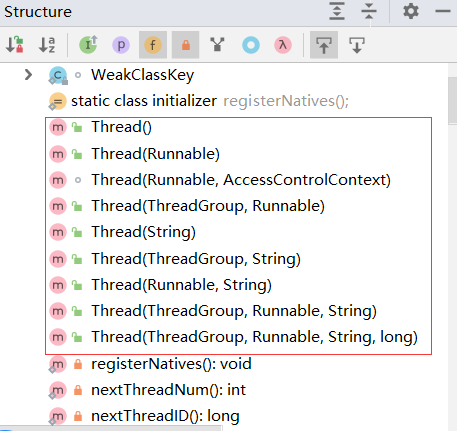
Thread构造器

1
2
3
4
5
6
7
8
9
10
11
12
13
14
15
16
17
18
19
20
21
22
23
24
25
26
27
28
29
30
31
32
33
34
35
36
37
38
39
40
41
42
43
44
45
46
47
48
49
50
51
52
53
54
55
56
57
58
59
60
61
62
63
64
65
66
67
68
69
70
71
72
73
74
75
76
77
78
79
80
81
82
83
84
85
86
87
88
89
90
91
92
93
94
95
96
97
98
99
100
101
102
103
104
105
106
107
108
109
110
111
112
113
114
115
116
117
118
119
120
121
122
123
124
125
126
127
128
129
130
131
132
133
134
135
136
137
138
139
140
141
142
143
144
145
146
147
148
149
150
151
152
153
154
155
156
157
158
159
160
161
162
163
164
165
166
167
168
169
170
171
172
173
174
175
176
177
178
179
180
181
182
183
184
185
186
187
188
189
190
191
192
193
194
195
196
197
198
199
200
201
202
203
204
205
206
207
208
209
210
211
212
213
214
215
216
217
218
219
220
221
222
223
224
225
226
227
228
229
230
231
232
233
234
235
236
237
238
239
240
/**
* Allocates a new {@code Thread} object. This constructor has the same
* effect as {@linkplain #Thread(ThreadGroup,Runnable,String) Thread}
* {@code (null, null, gname)}, where {@code gname} is a newly generated
* name. Automatically generated names are of the form
* {@code "Thread-"+}<i>n</i>, where <i>n</i> is an integer.
*/
public Thread() {
init(null, null, "Thread-" + nextThreadNum(), 0);
}

/**
* Allocates a new {@code Thread} object. This constructor has the same
* effect as {@linkplain #Thread(ThreadGroup,Runnable,String) Thread}
* {@code (null, target, gname)}, where {@code gname} is a newly generated
* name. Automatically generated names are of the form
* {@code "Thread-"+}<i>n</i>, where <i>n</i> is an integer.
*
* @param target
* the object whose {@code run} method is invoked when this thread
* is started. If {@code null}, this classes {@code run} method does
* nothing.
*/
public Thread(Runnable target) {
init(null, target, "Thread-" + nextThreadNum(), 0);
}

/**
* Creates a new Thread that inherits the given AccessControlContext.
* This is not a public constructor.
*/
Thread(Runnable target, AccessControlContext acc) {
init(null, target, "Thread-" + nextThreadNum(), 0, acc, false);
}

/**
* Allocates a new {@code Thread} object. This constructor has the same
* effect as {@linkplain #Thread(ThreadGroup,Runnable,String) Thread}
* {@code (group, target, gname)} ,where {@code gname} is a newly generated
* name. Automatically generated names are of the form
* {@code "Thread-"+}<i>n</i>, where <i>n</i> is an integer.
*
* @param group
* the thread group. If {@code null} and there is a security
* manager, the group is determined by {@linkplain
* SecurityManager#getThreadGroup SecurityManager.getThreadGroup()}.
* If there is not a security manager or {@code
* SecurityManager.getThreadGroup()} returns {@code null}, the group
* is set to the current thread's thread group.
*
* @param target
* the object whose {@code run} method is invoked when this thread
* is started. If {@code null}, this thread's run method is invoked.
*
* @throws SecurityException
* if the current thread cannot create a thread in the specified
* thread group
*/
public Thread(ThreadGroup group, Runnable target) {
init(group, target, "Thread-" + nextThreadNum(), 0);
}

/**
* Allocates a new {@code Thread} object. This constructor has the same
* effect as {@linkplain #Thread(ThreadGroup,Runnable,String) Thread}
* {@code (null, null, name)}.
*
* @param name
* the name of the new thread
*/
public Thread(String name) {
init(null, null, name, 0);
}

/**
* Allocates a new {@code Thread} object. This constructor has the same
* effect as {@linkplain #Thread(ThreadGroup,Runnable,String) Thread}
* {@code (group, null, name)}.
*
* @param group
* the thread group. If {@code null} and there is a security
* manager, the group is determined by {@linkplain
* SecurityManager#getThreadGroup SecurityManager.getThreadGroup()}.
* If there is not a security manager or {@code
* SecurityManager.getThreadGroup()} returns {@code null}, the group
* is set to the current thread's thread group.
*
* @param name
* the name of the new thread
*
* @throws SecurityException
* if the current thread cannot create a thread in the specified
* thread group
*/
public Thread(ThreadGroup group, String name) {
init(group, null, name, 0);
}

/**
* Allocates a new {@code Thread} object. This constructor has the same
* effect as {@linkplain #Thread(ThreadGroup,Runnable,String) Thread}
* {@code (null, target, name)}.
*
* @param target
* the object whose {@code run} method is invoked when this thread
* is started. If {@code null}, this thread's run method is invoked.
*
* @param name
* the name of the new thread
*/
public Thread(Runnable target, String name) {
init(null, target, name, 0);
}

/**
* Allocates a new {@code Thread} object so that it has {@code target}
* as its run object, has the specified {@code name} as its name,
* and belongs to the thread group referred to by {@code group}.
*
* <p>If there is a security manager, its
* {@link SecurityManager#checkAccess(ThreadGroup) checkAccess}
* method is invoked with the ThreadGroup as its argument.
*
* <p>In addition, its {@code checkPermission} method is invoked with
* the {@code RuntimePermission("enableContextClassLoaderOverride")}
* permission when invoked directly or indirectly by the constructor
* of a subclass which overrides the {@code getContextClassLoader}
* or {@code setContextClassLoader} methods.
*
* <p>The priority of the newly created thread is set equal to the
* priority of the thread creating it, that is, the currently running
* thread. The method {@linkplain #setPriority setPriority} may be
* used to change the priority to a new value.
*
* <p>The newly created thread is initially marked as being a daemon
* thread if and only if the thread creating it is currently marked
* as a daemon thread. The method {@linkplain #setDaemon setDaemon}
* may be used to change whether or not a thread is a daemon.
*
* @param group
* the thread group. If {@code null} and there is a security
* manager, the group is determined by {@linkplain
* SecurityManager#getThreadGroup SecurityManager.getThreadGroup()}.
* If there is not a security manager or {@code
* SecurityManager.getThreadGroup()} returns {@code null}, the group
* is set to the current thread's thread group.
*
* @param target
* the object whose {@code run} method is invoked when this thread
* is started. If {@code null}, this thread's run method is invoked.
*
* @param name
* the name of the new thread
*
* @throws SecurityException
* if the current thread cannot create a thread in the specified
* thread group or cannot override the context class loader methods.
*/
public Thread(ThreadGroup group, Runnable target, String name) {
init(group, target, name, 0);
}

/**
* Allocates a new {@code Thread} object so that it has {@code target}
* as its run object, has the specified {@code name} as its name,
* and belongs to the thread group referred to by {@code group}, and has
* the specified <i>stack size</i>.
*
* <p>This constructor is identical to {@link
* #Thread(ThreadGroup,Runnable,String)} with the exception of the fact
* that it allows the thread stack size to be specified. The stack size
* is the approximate number of bytes of address space that the virtual
* machine is to allocate for this thread's stack. <b>The effect of the
* {@code stackSize} parameter, if any, is highly platform dependent.</b>
*
* <p>On some platforms, specifying a higher value for the
* {@code stackSize} parameter may allow a thread to achieve greater
* recursion depth before throwing a {@link StackOverflowError}.
* Similarly, specifying a lower value may allow a greater number of
* threads to exist concurrently without throwing an {@link
* OutOfMemoryError} (or other internal error). The details of
* the relationship between the value of the <tt>stackSize</tt> parameter
* and the maximum recursion depth and concurrency level are
* platform-dependent. <b>On some platforms, the value of the
* {@code stackSize} parameter may have no effect whatsoever.</b>
*
* <p>The virtual machine is free to treat the {@code stackSize}
* parameter as a suggestion. If the specified value is unreasonably low
* for the platform, the virtual machine may instead use some
* platform-specific minimum value; if the specified value is unreasonably
* high, the virtual machine may instead use some platform-specific
* maximum. Likewise, the virtual machine is free to round the specified
* value up or down as it sees fit (or to ignore it completely).
*
* <p>Specifying a value of zero for the {@code stackSize} parameter will
* cause this constructor to behave exactly like the
* {@code Thread(ThreadGroup, Runnable, String)} constructor.
*
* <p><i>Due to the platform-dependent nature of the behavior of this
* constructor, extreme care should be exercised in its use.
* The thread stack size necessary to perform a given computation will
* likely vary from one JRE implementation to another. In light of this
* variation, careful tuning of the stack size parameter may be required,
* and the tuning may need to be repeated for each JRE implementation on
* which an application is to run.</i>
*
* <p>Implementation note: Java platform implementers are encouraged to
* document their implementation's behavior with respect to the
* {@code stackSize} parameter.
*
*
* @param group
* the thread group. If {@code null} and there is a security
* manager, the group is determined by {@linkplain
* SecurityManager#getThreadGroup SecurityManager.getThreadGroup()}.
* If there is not a security manager or {@code
* SecurityManager.getThreadGroup()} returns {@code null}, the group
* is set to the current thread's thread group.
*
* @param target
* the object whose {@code run} method is invoked when this thread
* is started. If {@code null}, this thread's run method is invoked.
*
* @param name
* the name of the new thread
*
* @param stackSize
* the desired stack size for the new thread, or zero to indicate
* that this parameter is to be ignored.
*
* @throws SecurityException
* if the current thread cannot create a thread in the specified
* thread group
*
* @since 1.4
*/
public Thread(ThreadGroup group, Runnable target, String name,
long stackSize) {
init(group, target, name, stackSize);
}

Thread类的init方法初始化线程

1
2
3
4
5
6
7
8
9
10
11
12
13
14
15
16
17
18
19
20
21
22
23
24
25
26
27
28
29
30
31
32
33
34
35
36
37
38
39
40
41
42
43
44
45
46
47
48
49
50
51
52
53
54
55
56
57
58
59
60
61
62
63
64
65
66
67
68
69
70
71
72
73
74
75
/**
* Initializes a Thread.
*
* @param g the Thread group
* @param target the object whose run() method gets called
* @param name the name of the new Thread
* @param stackSize the desired stack size for the new thread, or
* zero to indicate that this parameter is to be ignored.
* @param acc the AccessControlContext to inherit, or
* AccessController.getContext() if null
* @param inheritThreadLocals if {@code true}, inherit initial values for
* inheritable thread-locals from the constructing thread
*/
private void init(ThreadGroup g, Runnable target, String name,
long stackSize, AccessControlContext acc,
boolean inheritThreadLocals) {
if (name == null) {
throw new NullPointerException("name cannot be null");
}

this.name = name;

Thread parent = currentThread();
SecurityManager security = System.getSecurityManager();
if (g == null) {
/* Determine if it's an applet or not */

/* If there is a security manager, ask the security manager
what to do. */
if (security != null) {
g = security.getThreadGroup();
}

/* If the security doesn't have a strong opinion of the matter
use the parent thread group. */
if (g == null) {
g = parent.getThreadGroup();
}
}

/* checkAccess regardless of whether or not threadgroup is
explicitly passed in. */
g.checkAccess();

/*
* Do we have the required permissions?
*/
if (security != null) {
if (isCCLOverridden(getClass())) {
security.checkPermission(SUBCLASS_IMPLEMENTATION_PERMISSION);
}
}

g.addUnstarted();

this.group = g;
this.daemon = parent.isDaemon();
this.priority = parent.getPriority();
if (security == null || isCCLOverridden(parent.getClass()))
this.contextClassLoader = parent.getContextClassLoader();
else
this.contextClassLoader = parent.contextClassLoader;
this.inheritedAccessControlContext =
acc != null ? acc : AccessController.getContext();
this.target = target;
setPriority(priority);
if (inheritThreadLocals && parent.inheritableThreadLocals != null)
this.inheritableThreadLocals =
ThreadLocal.createInheritedMap(parent.inheritableThreadLocals);
/* Stash the specified stack size in case the VM cares */
this.stackSize = stackSize;

/* Set thread ID */
tid = nextThreadID();
}

线程状态转换

发表于 2019-06-30 分类于 java , 后端 , 并发 , 多线程

Thread类中的状态枚举

1
2
3
4
5
6
7
8
9
10
11
12
13
14
15
16
17
18
19
20
21
22
23
24
25
26
27
28
29
30
31
32
33
34
35
36
37
38
39
40
41
42
43
44
45
46
47
48
49
50
51
52
53
54
55
56
57
58
59
60
61
62
63
64
public enum State {
/**
* Thread state for a thread which has not yet started.
*/
NEW,

/**
* Thread state for a runnable thread. A thread in the runnable
* state is executing in the Java virtual machine but it may
* be waiting for other resources from the operating system
* such as processor.
*/
RUNNABLE,

/**
* Thread state for a thread blocked waiting for a monitor lock.
* A thread in the blocked state is waiting for a monitor lock
* to enter a synchronized block/method or
* reenter a synchronized block/method after calling
* {@link Object#wait() Object.wait}.
*/
BLOCKED,

/**
* Thread state for a waiting thread.
* A thread is in the waiting state due to calling one of the
* following methods:
* <ul>
* <li>{@link Object#wait() Object.wait} with no timeout</li>
* <li>{@link #join() Thread.join} with no timeout</li>
* <li>{@link LockSupport#park() LockSupport.park}</li>
* </ul>
*
* <p>A thread in the waiting state is waiting for another thread to
* perform a particular action.
*
* For example, a thread that has called <tt>Object.wait()</tt>
* on an object is waiting for another thread to call
* <tt>Object.notify()</tt> or <tt>Object.notifyAll()</tt> on
* that object. A thread that has called <tt>Thread.join()</tt>
* is waiting for a specified thread to terminate.
*/
WAITING,

/**
* Thread state for a waiting thread with a specified waiting time.
* A thread is in the timed waiting state due to calling one of
* the following methods with a specified positive waiting time:
* <ul>
* <li>{@link #sleep Thread.sleep}</li>
* <li>{@link Object#wait(long) Object.wait} with timeout</li>
* <li>{@link #join(long) Thread.join} with timeout</li>
* <li>{@link LockSupport#parkNanos LockSupport.parkNanos}</li>
* <li>{@link LockSupport#parkUntil LockSupport.parkUntil}</li>
* </ul>
*/
TIMED_WAITING,

/**
* Thread state for a terminated thread.
* The thread has completed execution.
*/
TERMINATED;
}

线程状态转换图

线程状态转换图

Hello World

发表于 2019-06-29

Welcome to Hexo! This is your very first post. Check documentation for more info. If you get any problems when using Hexo, you can find the answer in troubleshooting or you can ask me on GitHub.

Quick Start

Create a new post

1
$ hexo new "My New Post"

More info: Writing

Run server

1
$ hexo server

More info: Server

Generate static files

1
$ hexo generate

More info: Generating

Deploy to remote sites

1
$ hexo deploy

More info: Deployment

shoufeng

3 日志
4 分类
4 标签
© 2019 shoufeng
由 Hexo 强力驱动 v3.9.0
|
主题 – NexT.Pisces v7.1.2