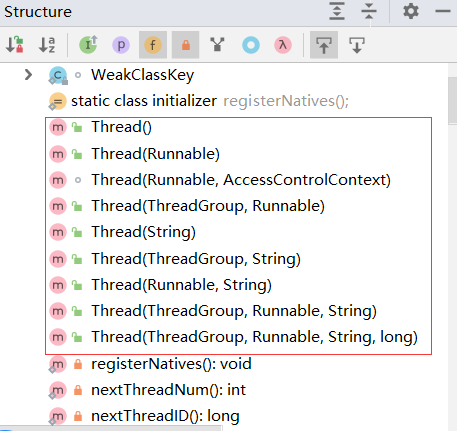
/** * Allocates a new {@code Thread} object. This constructor has the same * effect as {@linkplain #Thread(ThreadGroup,Runnable,String) Thread} * {@code (null, null, gname)}, where {@code gname} is a newly generated * name. Automatically generated names are of the form * {@code "Thread-"+}<i>n</i>, where <i>n</i> is an integer. */ publicThread(){ init(null, null, "Thread-" + nextThreadNum(), 0); }
/** * Allocates a new {@code Thread} object. This constructor has the same * effect as {@linkplain #Thread(ThreadGroup,Runnable,String) Thread} * {@code (null, target, gname)}, where {@code gname} is a newly generated * name. Automatically generated names are of the form * {@code "Thread-"+}<i>n</i>, where <i>n</i> is an integer. * * @param target * the object whose {@code run} method is invoked when this thread * is started. If {@code null}, this classes {@code run} method does * nothing. */ publicThread(Runnable target){ init(null, target, "Thread-" + nextThreadNum(), 0); }
/** * Creates a new Thread that inherits the given AccessControlContext. * This is not a public constructor. */ Thread(Runnable target, AccessControlContext acc) { init(null, target, "Thread-" + nextThreadNum(), 0, acc, false); }
/** * Allocates a new {@code Thread} object. This constructor has the same * effect as {@linkplain #Thread(ThreadGroup,Runnable,String) Thread} * {@code (group, target, gname)} ,where {@code gname} is a newly generated * name. Automatically generated names are of the form * {@code "Thread-"+}<i>n</i>, where <i>n</i> is an integer. * * @param group * the thread group. If {@code null} and there is a security * manager, the group is determined by {@linkplain * SecurityManager#getThreadGroup SecurityManager.getThreadGroup()}. * If there is not a security manager or {@code * SecurityManager.getThreadGroup()} returns {@code null}, the group * is set to the current thread's thread group. * * @param target * the object whose {@code run} method is invoked when this thread * is started. If {@code null}, this thread's run method is invoked. * * @throws SecurityException * if the current thread cannot create a thread in the specified * thread group */ publicThread(ThreadGroup group, Runnable target){ init(group, target, "Thread-" + nextThreadNum(), 0); }
/** * Allocates a new {@code Thread} object. This constructor has the same * effect as {@linkplain #Thread(ThreadGroup,Runnable,String) Thread} * {@code (null, null, name)}. * * @param name * the name of the new thread */ publicThread(String name){ init(null, null, name, 0); }
/** * Allocates a new {@code Thread} object. This constructor has the same * effect as {@linkplain #Thread(ThreadGroup,Runnable,String) Thread} * {@code (group, null, name)}. * * @param group * the thread group. If {@code null} and there is a security * manager, the group is determined by {@linkplain * SecurityManager#getThreadGroup SecurityManager.getThreadGroup()}. * If there is not a security manager or {@code * SecurityManager.getThreadGroup()} returns {@code null}, the group * is set to the current thread's thread group. * * @param name * the name of the new thread * * @throws SecurityException * if the current thread cannot create a thread in the specified * thread group */ publicThread(ThreadGroup group, String name){ init(group, null, name, 0); }
/** * Allocates a new {@code Thread} object. This constructor has the same * effect as {@linkplain #Thread(ThreadGroup,Runnable,String) Thread} * {@code (null, target, name)}. * * @param target * the object whose {@code run} method is invoked when this thread * is started. If {@code null}, this thread's run method is invoked. * * @param name * the name of the new thread */ publicThread(Runnable target, String name){ init(null, target, name, 0); }
/** * Allocates a new {@code Thread} object so that it has {@code target} * as its run object, has the specified {@code name} as its name, * and belongs to the thread group referred to by {@code group}. * * <p>If there is a security manager, its * {@link SecurityManager#checkAccess(ThreadGroup) checkAccess} * method is invoked with the ThreadGroup as its argument. * * <p>In addition, its {@code checkPermission} method is invoked with * the {@code RuntimePermission("enableContextClassLoaderOverride")} * permission when invoked directly or indirectly by the constructor * of a subclass which overrides the {@code getContextClassLoader} * or {@code setContextClassLoader} methods. * * <p>The priority of the newly created thread is set equal to the * priority of the thread creating it, that is, the currently running * thread. The method {@linkplain #setPriority setPriority} may be * used to change the priority to a new value. * * <p>The newly created thread is initially marked as being a daemon * thread if and only if the thread creating it is currently marked * as a daemon thread. The method {@linkplain #setDaemon setDaemon} * may be used to change whether or not a thread is a daemon. * * @param group * the thread group. If {@code null} and there is a security * manager, the group is determined by {@linkplain * SecurityManager#getThreadGroup SecurityManager.getThreadGroup()}. * If there is not a security manager or {@code * SecurityManager.getThreadGroup()} returns {@code null}, the group * is set to the current thread's thread group. * * @param target * the object whose {@code run} method is invoked when this thread * is started. If {@code null}, this thread's run method is invoked. * * @param name * the name of the new thread * * @throws SecurityException * if the current thread cannot create a thread in the specified * thread group or cannot override the context class loader methods. */ publicThread(ThreadGroup group, Runnable target, String name){ init(group, target, name, 0); }
/** * Allocates a new {@code Thread} object so that it has {@code target} * as its run object, has the specified {@code name} as its name, * and belongs to the thread group referred to by {@code group}, and has * the specified <i>stack size</i>. * * <p>This constructor is identical to {@link * #Thread(ThreadGroup,Runnable,String)} with the exception of the fact * that it allows the thread stack size to be specified. The stack size * is the approximate number of bytes of address space that the virtual * machine is to allocate for this thread's stack. <b>The effect of the * {@code stackSize} parameter, if any, is highly platform dependent.</b> * * <p>On some platforms, specifying a higher value for the * {@code stackSize} parameter may allow a thread to achieve greater * recursion depth before throwing a {@link StackOverflowError}. * Similarly, specifying a lower value may allow a greater number of * threads to exist concurrently without throwing an {@link * OutOfMemoryError} (or other internal error). The details of * the relationship between the value of the <tt>stackSize</tt> parameter * and the maximum recursion depth and concurrency level are * platform-dependent. <b>On some platforms, the value of the * {@code stackSize} parameter may have no effect whatsoever.</b> * * <p>The virtual machine is free to treat the {@code stackSize} * parameter as a suggestion. If the specified value is unreasonably low * for the platform, the virtual machine may instead use some * platform-specific minimum value; if the specified value is unreasonably * high, the virtual machine may instead use some platform-specific * maximum. Likewise, the virtual machine is free to round the specified * value up or down as it sees fit (or to ignore it completely). * * <p>Specifying a value of zero for the {@code stackSize} parameter will * cause this constructor to behave exactly like the * {@code Thread(ThreadGroup, Runnable, String)} constructor. * * <p><i>Due to the platform-dependent nature of the behavior of this * constructor, extreme care should be exercised in its use. * The thread stack size necessary to perform a given computation will * likely vary from one JRE implementation to another. In light of this * variation, careful tuning of the stack size parameter may be required, * and the tuning may need to be repeated for each JRE implementation on * which an application is to run.</i> * * <p>Implementation note: Java platform implementers are encouraged to * document their implementation's behavior with respect to the * {@code stackSize} parameter. * * * @param group * the thread group. If {@code null} and there is a security * manager, the group is determined by {@linkplain * SecurityManager#getThreadGroup SecurityManager.getThreadGroup()}. * If there is not a security manager or {@code * SecurityManager.getThreadGroup()} returns {@code null}, the group * is set to the current thread's thread group. * * @param target * the object whose {@code run} method is invoked when this thread * is started. If {@code null}, this thread's run method is invoked. * * @param name * the name of the new thread * * @param stackSize * the desired stack size for the new thread, or zero to indicate * that this parameter is to be ignored. * * @throws SecurityException * if the current thread cannot create a thread in the specified * thread group * * @since 1.4 */ publicThread(ThreadGroup group, Runnable target, String name, long stackSize){ init(group, target, name, stackSize); }
/** * Initializes a Thread. * * @param g the Thread group * @param target the object whose run() method gets called * @param name the name of the new Thread * @param stackSize the desired stack size for the new thread, or * zero to indicate that this parameter is to be ignored. * @param acc the AccessControlContext to inherit, or * AccessController.getContext() if null * @param inheritThreadLocals if {@code true}, inherit initial values for * inheritable thread-locals from the constructing thread */ privatevoidinit(ThreadGroup g, Runnable target, String name, long stackSize, AccessControlContext acc, boolean inheritThreadLocals){ if (name == null) { thrownew NullPointerException("name cannot be null"); }
this.name = name;
Thread parent = currentThread(); SecurityManager security = System.getSecurityManager(); if (g == null) { /* Determine if it's an applet or not */
/* If there is a security manager, ask the security manager what to do. */ if (security != null) { g = security.getThreadGroup(); }
/* If the security doesn't have a strong opinion of the matter use the parent thread group. */ if (g == null) { g = parent.getThreadGroup(); } }
/* checkAccess regardless of whether or not threadgroup is explicitly passed in. */ g.checkAccess();
/* * Do we have the required permissions? */ if (security != null) { if (isCCLOverridden(getClass())) { security.checkPermission(SUBCLASS_IMPLEMENTATION_PERMISSION); } }
g.addUnstarted();
this.group = g; this.daemon = parent.isDaemon(); this.priority = parent.getPriority(); if (security == null || isCCLOverridden(parent.getClass())) this.contextClassLoader = parent.getContextClassLoader(); else this.contextClassLoader = parent.contextClassLoader; this.inheritedAccessControlContext = acc != null ? acc : AccessController.getContext(); this.target = target; setPriority(priority); if (inheritThreadLocals && parent.inheritableThreadLocals != null) this.inheritableThreadLocals = ThreadLocal.createInheritedMap(parent.inheritableThreadLocals); /* Stash the specified stack size in case the VM cares */ this.stackSize = stackSize;